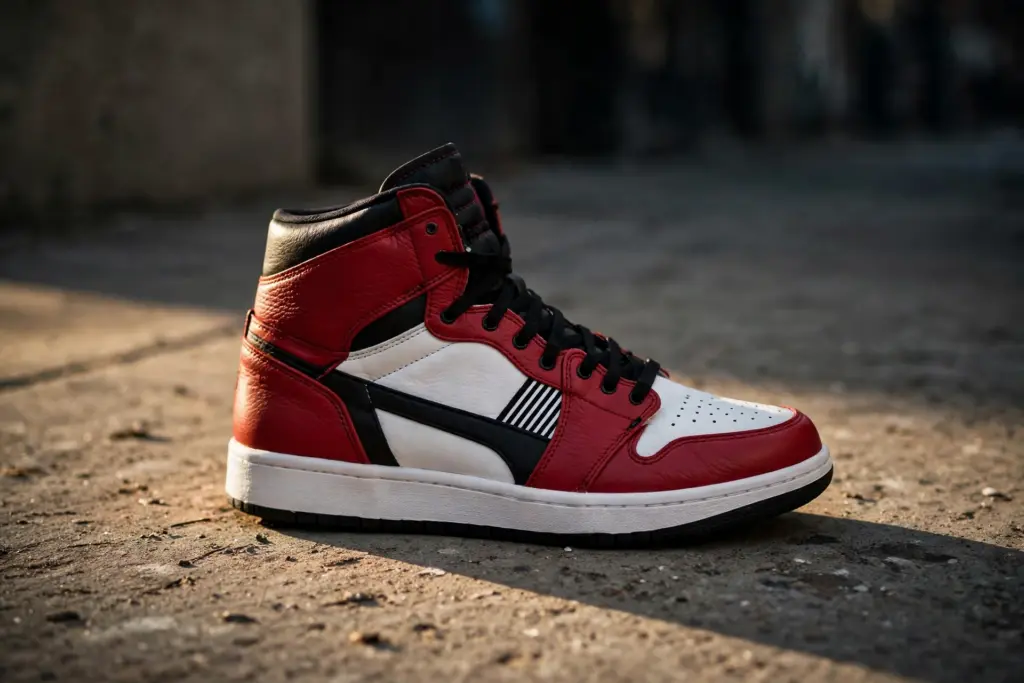
Ask five sneaker authenticators how to spot a fake Jordan 1 and you’ll get the same first answer: look at it from behind. The heel of a genuine pair curves in at the middle and flares at the top and bottom — the famous hourglass. Replicas, built on cheaper lasts, tend to come out straight, like a tube.
HIGH-FAKE RISK · 11 min read · Illustrations on this page are AI-generated, not product photos.
But here’s the part the quick guides skip. Jordan 1s have been produced for decades, across dozens of colorways, multiple factories and several shape revisions. Tells move. A detail that’s damning on one release can be standard on another, and authentication services openly publish slightly different reference points for different colorways. So read this guide the way the pros use it: as a stack of probabilities, not a single gotcha.
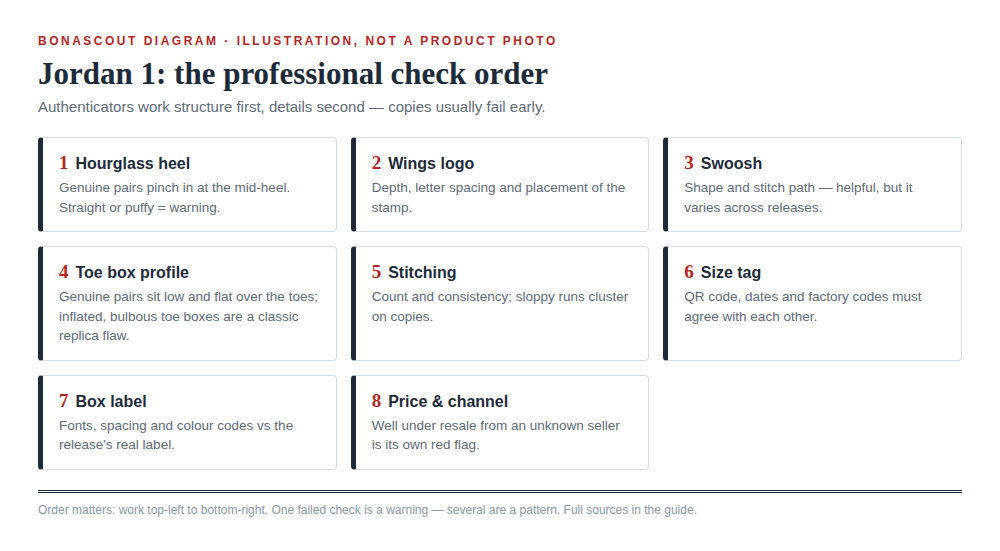
The 8 tells, strongest first
- The hourglass heel shape
- The Wings logo print
- The Swoosh cut and placement
- The toe box profile
- Stitching quality and spacing
- The size tag and its dates
- The box label
- Price and seller signals
1. The hourglass heel shape
Stand an unworn pair on a flat surface and look from directly behind. On genuine Highs the back profile narrows noticeably in the middle: the collar curves inward, then the heel cup flares out again toward the sole. Authentication guides attribute that taper to the factory moulds Nike uses, and it’s the single most-cited shape tell for the model.
Replicas usually miss it in one direction or the other — a back panel that’s straight top to bottom, or a curve so soft it disappears. Two cautions before you condemn a pair on shape alone. Worn pairs lose taper as the heel breaks in, so this check is really for new or lightly worn shoes. And some releases are simply built on a slimmer or chunkier profile than others. Shape opens the case; it doesn’t close it.
2. The Wings logo print
The Wings stamp on the ankle collar is small, recessed, and hard to print well — which is exactly why authenticators love it. On genuine pairs the embossing has real depth, the feather lines stay separate and crisp, and the lettering in “AIR JORDAN” is relatively thin. A widely documented detail: at the bottom of the wordmark, the R and the D connect.
On replicas the stamp often looks flat or muddy. The paint sits on the surface instead of settling into the grooves, feather gaps blur together, and the lettering runs thick. Check it under your phone’s torch at an angle — shallow stamps show themselves in raking light. One warning: print weight and spacing on the Wings logo genuinely differ between releases, so compare against reference images of the same colorway, not a random pair from another year.
3. The Swoosh cut and placement
Trace the Swoosh from the heel forward. On genuine pairs the leather tapers into a sharp, clean point — authentication guides describe replica Swooshes as thicker, with a blunt or rounded tip where worn cutting dies leave a sloppy edge. Stitching along the Swoosh should be fine and even, not chunky.
Now the honest caveat, because this tell gets oversold: Swoosh size, angle and exact placement vary across Jordan 1 releases more than almost any other detail. Limited editions and retros from different years place it differently, and a Swoosh that looks “too long” against one reference can be correct for its own colorway. Use the Swoosh for cut quality — sharp tip, clean edges, tidy stitching — and be careful using it for geometry unless your reference is the exact same shoe.
4. The toe box profile
Look at the shoe from the side, at table height. Genuine pairs sit relatively low and flat over the toes. One of the most consistent replica flaws across authentication guides is an inflated toe box: too high, too thick, too bulbous, as if the shoe is holding its breath.
The perforations tell a supporting story. On genuine pairs the toe holes are clean, evenly spaced and proportionate. On copies they’re often drilled too wide, or wander slightly off line. Neither flaw is rare on budget replicas, and both survive even on pairs that get the heel shape roughly right.
5. Stitching quality and spacing
Real quality control shows in boring places. Run your eye along the panel stitching: genuine pairs keep stitch length regular, lines straight, and thread weight consistent from panel to panel. Replicas tend to drift — a wobble here, a doubled stitch there, spacing that tightens and loosens along the same seam.
More stitching isn’t automatically better, either — some guides note replica stitching sitting closer together than retail pairs on certain panels. Judge consistency, not density. One sloppy stitch proves nothing; sloppiness everywhere is a pattern.
6. The size tag and its dates
Inside the shoe, the size tag carries the size, the factory code, a QR code and a production date range. This is the check replica factories most often fumble in the details: fonts that run too thick, spacing that crowds, a Jumpman or text weight that doesn’t match the retail tag for that release — and, best of all, dates that don’t make sense.
Cross-check three things. Does the style code on the tag match the style code on the box? Does the production window fit the release date of that colorway — a shoe can’t be manufactured after it launched, and a retro can’t predate its announcement by years? And does the QR code scan to something coherent rather than nothing at all? A tag can be copied; getting every cross-reference right at once is harder.
7. The box label
The label on the box end repeats the shoe’s identity: name, colorway, size, style code. On genuine retail boxes the print is sharp, the layout matches Nike’s format for the era, and every field agrees with the size tag inside the shoe. On replica packaging the label is a frequent weak point — fonts slightly off, text misaligned, or a style code that belongs to a different colorway entirely.
Boxes get swapped, though — a genuine pair can land in the wrong box through a messy stockroom. Treat a wrong label as a question for the seller, not a conviction.
8. Price and seller signals
Retired colorways trade at public, easily checked market prices. A seller offering a high-demand pair far below the going rate, with no receipt and no coherent story about where it came from, is asking you to subsidise the difference.
Authentication guides give the same dull advice because it works: check recent sale prices before you meet a seller, and prefer channels with an authentication step or a returns policy when the money is serious. Boring beats sorry.
Real vs fake at a glance
| Tell | Genuine Jordan 1 | Typical replica |
|---|---|---|
| Heel shape (from behind) | Visible hourglass taper on unworn pairs | Straight, tube-like back panel |
| Wings logo | Deep, crisp stamp; thin lettering; R and D connect | Shallow or blurry stamp; thick letters; paint sits on surface |
| Swoosh | Sharp pointed tip, clean cut, fine stitching | Blunt rounded tip, chunky stitching (placement varies by release) |
| Toe box | Low, flat profile; neat even perforations | Inflated and bulky; holes too wide or uneven |
| Stitching | Even length and spacing across panels | Wandering lines, inconsistent spacing |
| Size tag | Correct fonts; style code and dates consistent with the release | Thick fonts; wrong or impossible production dates |
| Box label | Matches tag, colorway and era format | Off fonts, misalignment, wrong style code |
A final word on certainty
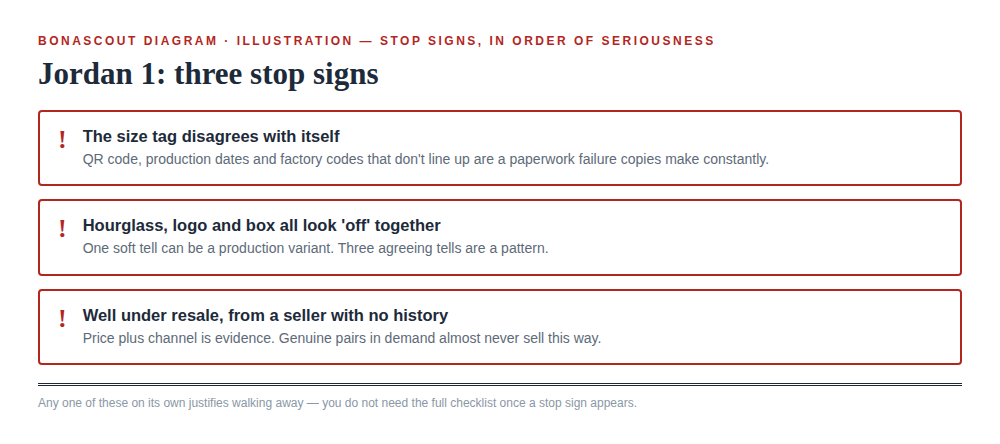
Top-tier replicas now pass several of these checks at once, and genuine pairs occasionally fail one thanks to factory variance. That’s not a reason to give up — it’s a reason to count. One failed tell is a question. Three failed tells, across the silhouette, the print and the paperwork, is an answer. And for a high-value pair, a paid authentication service with the shoes physically in hand will always beat any photo guide, this one included.
FAQ
Is the hourglass shape a guaranteed test?
No. It’s the strongest shape tell on most unworn Highs, but worn pairs lose taper and some releases are built slimmer than others. Use it as the first check, not the only one, and weigh it alongside the Wings print and the size tag.
My Swoosh looks longer than in photos of the same shoe. Is it fake?
Not necessarily. Swoosh size and placement genuinely vary by colorway and production year, which is why authenticators compare against the exact release. Judge the Swoosh mainly on cut quality — a sharp tip and clean stitching — before you judge its geometry.
The size tag’s QR code scans fine. Does that prove it’s real?
No. QR codes are copyable like everything else printed. The tag’s real value is consistency: style code matching the box, fonts matching the era, and production dates that fit the colorway’s actual release timeline.
Can a real pair come in a box with a wrong label?
Yes — boxes get mixed up in shops, warehouses and resale. A mismatched label should prompt questions and a harder look at the shoes themselves, but the shoes are the evidence. The box is supporting paperwork.
Sources
- Nike Shoe Bot — How to Spot a Fake Air Jordan 1: Legit Check Guide (hourglass heel, Wings R-and-D detail, Swoosh cut)
- Legit Check App — Jordan 1 Electro Orange: How to Spot Fakes (toe box, perforations, logo weighting by colorway)
- Legit Check App — Jordan 1 Chicago: Authentic or Fake (rear profile, lettering, cross-stitching)
- LegitGrails — How to Spot Real vs Fake Jordan 1 Retro Bred 2016 (size tag fonts, production dates, heel and stitching)
- Empire Drop — How to Legit Check Jordan 1: Real vs Fake Guide (colorway-specific variation, quick checklist)
This article was created with AI assistance and reviewed by our editorial team before publishing.