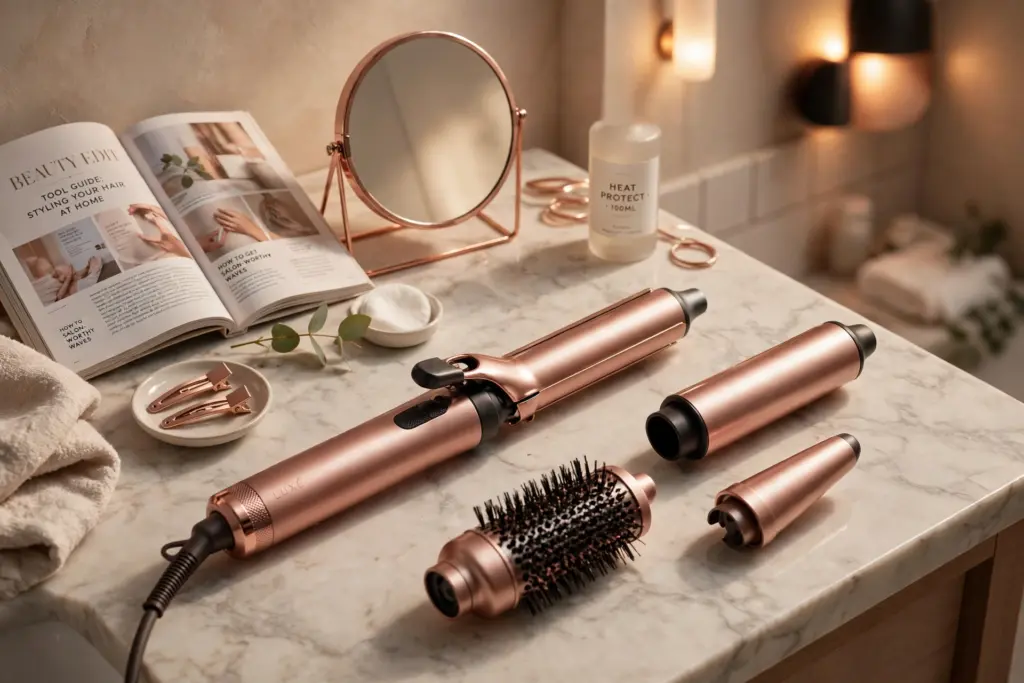
A fake Airwrap is worse than a fake handbag. A handbag that fools you costs you money. A counterfeit styling tool plugs into your mains electricity, heats up next to your head, and was built by someone who skipped every safety standard Dyson is required to meet. That’s not us being dramatic — it’s the reason Dyson itself warns buyers about counterfeit machines and refuses to service them.
SOURCED CHECKS · 9 min read · Illustrations on this page are AI-generated, not product photos.
The good news: Airwrap copies have to fake a lot of engineering, and they cut corners in places you can check. This guide pulls together the checks Dyson points buyers toward, the serial-number process as Dyson describes it, and the physical details that established comparison guides document. Do them in order — seller first, machine second.
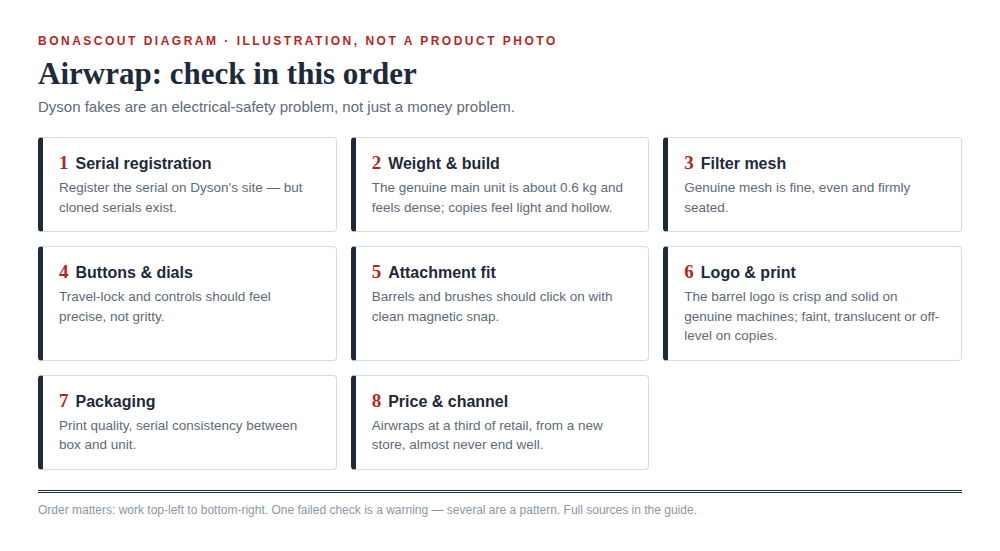
The checks, in order
- The serial number and Dyson registration
- Weight and general build
- The filter mesh
- Buttons, dials and switch feel
- Attachments: fit and magnets
- Logo and printed details
- Packaging and paperwork
- Price and sales channel
1. The serial number and Dyson registration
Find the serial label first. On the Airwrap, the label sits on the power cord near the plug. A genuine serial can be registered with Dyson, which activates the machine’s guarantee and ties it to Dyson’s records. A serial that Dyson’s system rejects, or one that comes back as already registered to someone else, is a serious problem.
But keep Dyson’s own warning in view: counterfeiters copy serial stickers and warranty cards from real machines. A label that looks right — or even a number that registers — doesn’t close the case, which is why Dyson directs doubtful owners to contact Dyson Customer Care with the number and let them dig further. If a seller won’t let you see the serial label before you pay, that’s your answer about the seller, whatever the number turns out to be.
2. Weight and general build
Dyson lists the Airwrap’s main unit at roughly 0.6 kg — about 1.3 lb — and genuine machines feel dense for their size: solid barrel, no flex, no creaks, seams that meet flush. Copies are built to a price, and the weight is where the saving usually shows. A styler that feels noticeably light or hollow in the hand deserves suspicion.
Run your fingers along the joins while you’re at it. Genuine fit and finish is boringly consistent — same gap width all the way around, no sharp moulding edges, nothing that shifts when you squeeze gently. A machine can be the right weight and still fail here, but a machine that’s light and creaky has failed twice in ten seconds.
3. The filter mesh
The filter cage at the base of the handle is a part most buyers never look at, which makes it a good tell. On a genuine Airwrap the mesh is fine, even, and cleanly fitted, with the filter cover removing and refitting smoothly — it’s a part designed to be taken off and cleaned regularly, and it feels like it.
On copies the mesh is frequently coarser, unevenly cut, or slightly loose in its frame, and the cover can feel gritty or reluctant. It’s a small part with nowhere to hide cost-cutting.
4. Buttons, dials and switch feel
Work every control. On genuine machines the buttons sit centred in their cut-outs, travel smoothly, and land with a consistent, positive click. The airflow and temperature controls respond in clean, repeatable steps.
Comparison guides flag the copies here: a main button that sits slightly off-centre, switches that feel mushy or uneven from one press to the next, controls that wobble in place. None of these is exotic engineering. They’re what happens when tolerances are a suggestion instead of a specification.
5. Attachments: fit and magnets
Click every attachment on and off. Genuine Airwrap attachments locate positively, hold with a firm magnetic assist, and sit flush with no rocking. Barrels and brushes should spin and seat exactly as designed, every time, not most times.
Loose fit is one of the most documented counterfeit tells: attachments that wobble, sit at a slight angle, or detach with less resistance than they should. One more trap worth knowing — some sellers pair a genuine styler with fake attachments. Check the attachments with the same care as the machine: logo print, joins, edges, and fit, piece by piece.
6. Logo and printed details
Look at the Dyson logo on the barrel. On genuine machines it’s crisp and solid, cleanly applied as part of the finish. On copies it often appears faint or slightly translucent, printed rather than properly finished, sometimes a fraction off level.
Apply the same eye to every other printed mark — rating labels, warnings, the text on the cord label. Genuine print is sharp at reading distance and sharper up close. Blurring, smudged edges, or a font that’s nearly right are the counterfeit’s signature, here as everywhere.
7. Packaging and paperwork
A genuine Airwrap arrives in high-resolution, precisely printed packaging, with fitted inserts that hold each piece in its own place and the full set of Dyson documentation. Copies economise: box art that’s slightly soft, misspellings, generic inserts — or a “new” machine that turns up in no box at all.
As with every product in this series, weigh packaging as supporting evidence. A flawless box can be copied or reused; a sloppy one still tells you plenty.
8. Price and sales channel
Dyson holds its prices. The Airwrap is rarely discounted by anyone authorised to sell it, so the channel checks matter as much as the physical ones. Dyson’s own advice to buyers is plain: purchase from Dyson directly, a Dyson Demo Store, or an approved retail partner.
Treat the standard counterfeit listing shapes accordingly — 40 to 70% off through a social-media shop, a seller with no invoice, no returns and no written warranty, marketplace listings from accounts with no history. Dyson also points out that it can’t service counterfeit machines and won’t refund them. Buy a fake and you’re not just out the money; you’re out the guarantee, the service network, and the safety testing, all at once.
Real vs fake at a glance
| Check | Genuine Airwrap | Typical counterfeit |
|---|---|---|
| Serial number | On the cord label; registers with Dyson and activates the guarantee | Rejected, already registered to someone else — or copied from a real machine |
| Weight and build | Main unit roughly 0.6 kg (about 1.3 lb); dense, flush seams, no creaks | Noticeably light or hollow; uneven gaps; flex and creaks |
| Filter mesh | Fine, even mesh; cover removes and refits smoothly | Coarse or uneven mesh; loose fit; gritty cover |
| Buttons | Centred, smooth travel, consistent click | Off-centre main button; mushy, uneven feel |
| Attachments | Click in positively, firm magnetic hold, sit flush | Wobble, sit at an angle, detach too easily |
| Logo and print | Solid, crisp logo and labels | Faint or translucent logo print; soft or smudged text |
| Channel | Dyson or an approved retail partner, with invoice and guarantee | Deep-discount social or marketplace seller; no invoice, no returns |
If you already bought one
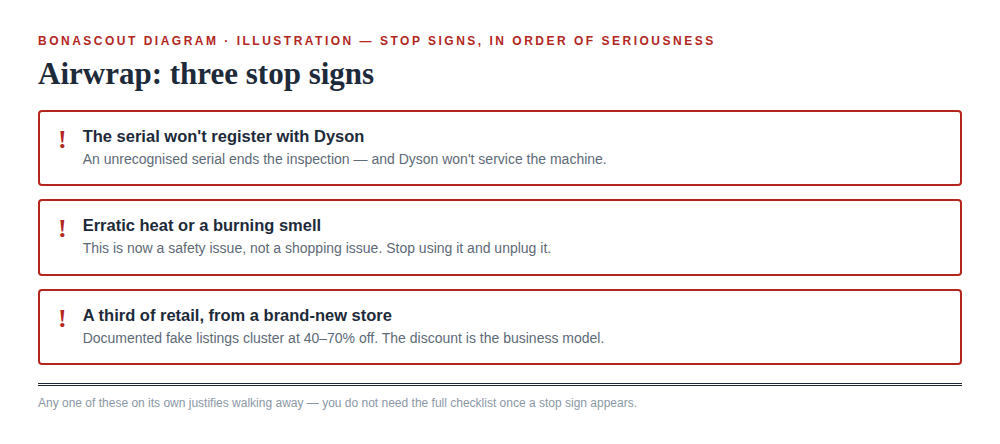
Stop using it until you’ve run the serial through Dyson and, if there’s any doubt, spoken to Dyson Customer Care. That isn’t over-caution: a counterfeit heated appliance carries electrical and overheating risks that a fake wallet never will, and comparison guides note fakes heating inconsistently or failing early. Then pursue the refund through the platform or your card issuer while the window is open, keeping the listing screenshots and the serial label photo as your evidence.
FAQ
Can I check a Dyson serial number online?
You can register it with Dyson, and you should — a rejected serial or one already registered elsewhere is a major red flag. But Dyson cautions that counterfeiters copy serial stickers, so treat registration as one strong check among several, and contact Dyson Customer Care if anything else about the machine bothers you.
Will Dyson repair a fake Airwrap?
No. Dyson didn’t make it, so it can’t service it, and it won’t refund it either. That’s a large part of the real cost of a counterfeit: no guarantee, no service network, no safety assurance behind a heated mains appliance.
A seller offers a sealed Airwrap at half price. What should I ask for?
The serial label photo, an invoice, and written warranty terms — before money moves. A legitimate seller can produce all three without drama. Evasion on any of them, at that discount, tells you what you’re actually being sold.
The machine works fine. Does it matter if it’s a copy?
Yes, for this product category more than most. “Works fine” describes today. It says nothing about electrical safety, heat control over time, or what happens when it fails — and with no guarantee or service path, every one of those risks sits with you.
Sources
- Dyson (official) — Airwrap Complete Long specifications (main-unit weight 0.61 kg)
- Dyson (official) — Airwrap support and machine registration (serial registration process and owner support)
- Xclusive (authorised Dyson reseller) — How to Spot a Fake Dyson Airwrap (serial label position, Dyson’s position on copied stickers, service refusal, authorised channels)
- We the Dryers — How to Tell the Difference Between a Real and Fake Dyson Airwrap (packaging, performance and overheating signs, seller red flags)
- Accio — Dyson Airwrap Fake vs Real: Spot the Difference (logo finish, button alignment, plug and adapter details)
This article was created with AI assistance and reviewed by our editorial team before publishing.